Search This Blog

Monday, November 4, 2013

This blog is so totes awesome! TTFN!!

Sheila@15: so what did u like think of the book TTYL!!!??? wasnt it just the best!
Sheila@27: It was okay.  I really did enjoy the medium it was written in.  I think many teens would enjoy reading something in this format because it comines their language with a medium that they are more intimately familiar with.
Sheila@15: yeah thats cool but didnt u luv the story!?! *waves hands* they felt soooo real to me. Poor Angie with her boys and Maddie is soooo sad Zoe is just crazy!!
Sheila@27: I thought the story was really interesting, but I had trouble relating to it. I'm sure my students will be able to connect with the struggles of these girls more than I am able to.  I guess I just need to be considerate of their interests when it comes to reading.  What do you think boys your age would think of this book?
Sheila@15: who cares what the boyz think!? they totes dont understand what it is like to be a girl  this book is all about supporting girlz and girl power! didnt you just love the part where they took quizes!? i take those quizes all the time! i linked mine in
Sheila@27: Yeah, I really did like the part where they talked about taking those quizes because that was something I did often with my friends when I was your age.  I also think it would be fun to take some of these quizes as a class and see what they come up with and talk about how these things work and what they say about us.  It would be a good activity to connect to our characters. 
Sheila@15: that sounds totes lame :( y cant you just relax and have fun!?!
Sheila@27: Well, I know you want to just have fun with it, but I want to come up with fun ways for you to engage with it. Like Sam Intrator and Robert Kunzman explain in their article, there is a lot of value to be had in the electronic forums in which adolescents participate.  I want to bring these forms into my classroom so that you can have more fun.
Sheila@15: oooooohhhhhh i guess that makes sense but dont make it boring. thats the worst part about classes is that the teacher just stands up there and talks at us and i just write notes to my bf and my friends
Sheila@27: So, what would you like to see more of in your own classes?
Sheila@15: i want more fun in classes more games more fun days y cant we do more things that we enjoy???!? no more worksheets and more discussions!
Sheila@27: Well, I think we could do something with that.  I'll take your input and try to edit my class to make it more fun and engaging.  Don't be afriad to tell me what you think would help you learn; you are the authority of your own knowledge so you need to be proactive about it.


Fathful audience, I know this looks totes strange (LOL), but this is what I had to read for class this week. I absolutely loved the form of the text.  I couldn't believe how much depth there was to characters that only spoke through IMs.  Myracle's book is so well developed. I felt like I knew these girls by the end of reading it.  Now I'm debating on whether I should read the next book! I only had one problem with the book and that was the content.  At times, I just found it trite and it really tried my patience at times, but I think this is because I can't entirely relate to this age group anymore.  I mean, there were things that I can totally remember doing at 15 (which is why I set up my intro the way I did).  I loved the references to the quizes and I thought these would be great to bring into a classroom and take some quizzes and even make some quizzes if we could.  I also like how much character development there is in so few words.  I think students would like exploring this as well.  I thought I could bring in gaming dialoge that they could build characters from and this would tie in to their writing outside of the classroom.  Although I might not use this book as an assigned text, I can definitely see its value for drawing students into lessons.  Maybe they could even understand Shakespeare better by seeing how characters are developed through dialogue.

Monday, September 30, 2013

"Words were different when they lived inside of you"

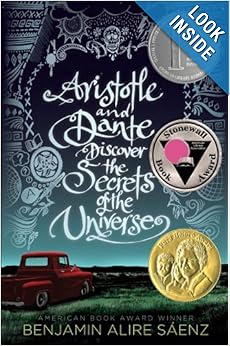
Faithful readers, the quote in my title comes from the book I read this past week.  The book was Aristotle and Dante Discover the Secrets of the Universe and it was fabulous.  With many of the books I've read for this class, I started out skeptical and then grew to love it, but with this book I started out loving it and only grew to enjoy it even more.  Everything about this novel appealed to me.  The characters felt real and I thought it described the world of an adolescent really accurately. 
Since we have been talking about it in class, I was thinking about what this story adds to my understanding of the adolescent experience and I think that this book really highlights a lot of the struggles adolescents face.  There are parent issues, sexuality concerns, school worries and friend problems.  It ties in so many details together and gives a unique perspective because it also connects to issues of culture and belonging to one's culture.  I just can't believe how much this story has going on and it still has a lot of really profound things to say about life!

One of my favorite quotes from the book I included in the title of my blog this week: "Words were different when they lived inside of you" (31). This is so true for me and probably for adolescents as well. It is so exciting to learn new words or to learn a word that is really describing what I want. I love trying to select the perfect word to describe something.  It is just so satisfying to find exactly the right word to describe a situation.  There is something so different about internalizing a word than just using a thesaurus to find something else.

The other thing that I really liked about this novel was how profound it could be.  I think adolescents have such a unique perspective on the world, so they have the ability to say things that are deep in meaning but simple and true.  For example, Ari (Aristotle) says at one point, "Something happened inside me as I looked out into the vast universe.  Through that telescope, the world was closer and
larger than I'd ever imagined. And it was all so beautiful and overwhelming and - I don't know - it made me aware that there was something inside of me that mattered" (42). This summed up adolescents to me.  Going through high school can bring the world into perspective for an adolescent and they can find a purpose or a path.  Adolescents is really that time to explore and understand the world and it lets them find something (anything) about themselves that they can cling to.

I think maybe Trites is getting at this also in her chapter on sex and adolescents.  There is a lot of insecurity and lack of knowledge for adolescents surrounding sex and sexuality, but there are also opportunities to wield sexuality in a powerful way. In this text, the character Ileana clearly uses her sexuality to get what she wants, but Dante is just experimenting with his sexuality and Ari is trying to avoid sexuality all together.  Once they start to identify with some form of sexuality though, both Dante and Ari latch on to that understanding and use it as a means to understanding more about themselves.  This is a clear connection to the quote about the telescope.  They are starting to understand this universe (sexuality), and as it comes into view they are able to identify with it and use it to benefit their own agendas.

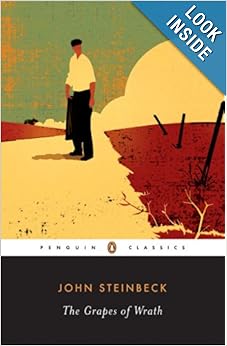
The last thing I want to talk about, and probably the most exciting part about reading this book, is how great I think it would be to teach this book in a high school class! I think this book, more than any of the others I have read thus far, touches on more issues and explains them in a better way. I kept coming up with more and more ideas for this novel; more than any of the others.  My first idea was a tie in to The Grapes of Wrath because Ari mentions reading it in the book and it would be great to use this as a jumping off point for talking about the way different people have dealt with poverty.  Each book takes a unique perspective on poverty and what it means and there could be discussions on how each family works through poverty or even over comes it.  Because I had so many ideas, I wanted to try to do something different with my information, so I put it all together in a really neat Glog! Check it out here. It was a lot of fun to do and I could see myself using this as an assignment for my students or even as a way to teach sometimes rather than just using a powerpoint or lecturing.


Monday, September 23, 2013

"The question of belonging is complicated" Zlata Filipovic

The Diary of a Young GirlThis week's reading was incredible! When we were given the list to choose from, I was really leaning toward a different book, but Katie convinced me that it would be a good idea.  I was excited about the idea of reading something that was like Anne Frank's diary because I have always wanted to read that. However, when I learned that it was about a girl caught in the war in Sarajevo, I was convinced that I would enjoy this book.  The very first thing that I wanted to look up before I started reading was where Sarajevo was and a little information about the war, because like many Americans I was very ignorant of the situation and what happened in the 90s.  So I went to my trusted source for all knowledge WIKIPEDIA! It really helped me appreciate the book and I became more informed on issues happening in the world. 
I guess I should tell you what the book was that I read.  Zlata's Diary is a story about a young girls time trapped in wartime Sarajevo.  It was really beautifully written; particularly when you consider the age of the writer and the things that she is going through. I was particularly fond of her emphatic responses to certain situations.  She was able to maintain this upbeat attitude despite very serious and life threatening challenges. I think one of my favorites parts is where Zlata recognizes that young people would have run the country better. She says "Of course, I'm 'young' and politics are conducted by 'grown-ups.' But I think we 'young' would do it better. We certainly wouldn't have chosen war."  This is so true and I think young adults have this feeling a lot.  They realize that adults may not have all of the right answers and that they may be able to do a better job.  I think this is an excellent realization to have and it reminds me of what Gaughan is trying to say in his two Chapters from Cultural Reflections. (I've included the link to the text in case curiosity turned to purchasing).

In the two chapters, Gaughan makes these amazing suggestions about how we can teach differently in the English classroom.  Personally, I thought his suggestions were fantastic and I would love to have the confidence as a teacher to implement his strategies.  I thought that for Zlata's Diary I could use it as a stepping off point for talking about cultural awareness and maybe implement some of his ideas about consumerism and how we identify ourselves.  Zlata often talks about not having enough food, water, or heat.  Students could consider the cultural value of these objects and other things that they consider important to their culture and their personal identity. 

I also thought that Zlata's Diary would be a great stepping off point for talking about journal writings and even as a tie in to Anne Frank's Diary. Students could talk about differences and war and issues surrounding innocent people and war.  It would be a really interesting connection and comparison because the wars are so very different and talked about in different ways. I even thought about how the writing format relates to Perks of Being a Wallflower and maybe we could draw connections between these two texts and the character's experiences. I can't believe how much I have enjoyed this book and how many ideas I have about what I could do with it in the classroom.  I think my lesson plan will probably use this text in some way.

Monday, September 16, 2013

"But even if we don't have the power to choose where we come from, we can still choose where we go from there. We can still do things."-Chbosky

Perks of Being a Wallflower was an amazing read. When I first started, I was understandably skeptical. I loved the letter format that the author chose to use, but the content was very strange at first. Once I became more invested in the characters, I actually enjoyed the content more.  These characters were so real to me and the main character Charlie was so interesting, I just wanted to figure him out.  Even when the big twist came, I wasn't ready for it. After reading the book I am really looking forward to seeing the movie because I want to see how it compares. I'll do a follow-up post once I see it, but for now I want to consider the teaching application of this novel.
As you can see, banned book week is fast upon us, and not surprisingly, Perks is on the list for the top censored or banned books in the US. When I started reading this book, the controversial content was all I could think about.  I was like, how in the world would I teach this book in a class?? Could I just teach excerpts? Would that work? What if I got in trouble? I guess I would have to have a really good reason for teaching this book, but I do have a good reason. This book is incredible, I wish someone would have made me read it in high school.  Poor Charlie goes though so many of the same feelings that I had in middle school and high school. I had sever anxiety issues in middle school and I felt like something was completely wrong with me, but I didn't have the close friends like Patrick and Sam.  However, I also didn't do as many controversial things as Charlie ended up doing.  But how could I teach this book?
First I started looking up resources about teaching controversial books: See here and here. I thought these were great introductory resources to draw from, but I still thought there were some difficulties with teaching. As I went on reading the book, I kept thinking about ways to make it work in a class because I think there were parts that were really thought provoking.  In particular, the idea of being a wallflower or being infinite would be interesting topics for students to talk about.  Thus, I was thinking that maybe with the way it is broken up I could pick out particular letters for students to read rather than reading the whole text (particularly if I think there is gonna be an issue with the content).  This way students could still get the inspiration from the piece but we could avoid the controversy.  The other way I was thinking about teaching this text would be what was suggested in the first example I linked to.  Maybe in an upper level course we could discuss banned books or controversial texts and approach the book from that perspective but still validate the importance of the text.  It is a tough balancing act to maintain. My other idea for this novel was to do what Jeffrey Wilhelm suggested in his book You Gotta BE the Book. Maybe we have to understand what our students would be comfortable reading and use that as a jumping off point to suggest things like Perks. I just think it's hard to limit a book based on its content, but I also don't want to have outraged parents on my hands.

Sunday, September 8, 2013

“There are some themes, some subjects, too large for adult fiction; they can only be dealt with adequately in a children's book.” ― Philip Pullman

So, this is my blog.  Clearly I'm off to a great start by stating the obvious right off the bat.  If you need background on me, see my About Me section. It will probably help you understand where I'm coming from. Now on to the blogging...

Right now I'm taking a course at Shippensburg University on Young Adult (YA) Literature.  It is a course that I have really been looking forward to because I think it is really going to help me make sense of what I will be doing for the foreseeable future.  For our first weeks of class, we were divided into groups to read from a selection of classic YA novels.  I, for one, had never read any of the books that were on the list (I guess my high school education wasn't as good as I thought), but I was particularly interested in The Outsiders
I was interested in the novel because the students in one of the classes I observed had read the book and made posters about it and I thought the premise sounded kind of interesting.  From the very start of the book, I was hooked. The characters just felt very real to me and I could relate to their feelings even though it has been a long time since I was an adolescent. I also didn't mind how epic the story was because it seemed like in this world, these extreme things could really happen to these characters.  I have to admit that I was crying near the end though; I don't want to give away spoilers for those who haven't had a chance to read it yet, but it was just such a great story.  The feelings of the characters felt very real and the experiences were relatable (even for someone who thinks they may be beyond that stage in her life).

This lead me to the second part of our assignment.  We read a couple chapters from Roberta S. Trites's book Disturbing the Universe and it was an introduction to her take on YA literature.  Although this is very simplified, Trites basically argued that adolescent literature is based around the idea that YA are trying to find their place within the power structures that surround them.  In my notes on the chapters, I said that I agreed with Trites's suggestion, but I did not think that it was complete.  I'm not sure exactly what I would like to add (hopefully by the end of the semester I will have a better idea), but I just didn't think that power was the only thing YA literature focused on.  In the case of The Outsiders though, I  saw many examples of power present.

First, there is the obvious power struggle in Ponyboy's (main character - yeah I know, what a great name!) family.  He is clearly very attached to his brother Sodapop (another fantastic name!), but his relationship with his older brother Darrel is really strained.  I haven't seen it yet, but I really want to watch the movie version, because Patrick Swayze plays Darrel and I would love to see what he is like in that role. Tangent aside, there is a pretty clear power struggle between Pony and Darry (Darrel) because their parents were killed recently and Darry has taken responsibility for the two younger kids (Soda and Pony).  In typical over-protective brother fashion, Darry is hard on Pony when he does dumb things and the two fight.  In a very pivotal scene in the book, Darry actually hits Pony and the reaction it caused for me was very strong.  The author just really made you feel it.  This power struggle is ultimately worked-out (maybe not entirely) and it really works.  It feels real because Soda finally has enough of the two arguing and explains how he feels torn between them when they fight.  It was a really moving scene for me.  I think this power dynamic is a great representation because it shows how families interact with one another without necessarily involving the additional power of being the parent.  I think this would give YA reading the novel insight into what they may be going through with their parents, but in a relatable way because these are Pony's brothers and not ultimate authorities like parents can be seen as at times.

The other obvious power dynamic is between the Socials (Socs - pronounced Soshes) and the Greasers.  Now, when I first read this all I could think of was West Side Story and the scene where the guys are dancing and snapping, but as I read on, it got much better.  (It helped that it wasn't just a retelling of the Romeo and Juliet theme.) These were just kids who grew up in different worlds, but I loved the way Pony really drew them together.  He could see that there were pros and cons to each lifestyle and that is what made him a great character.  For him, it wasn't just about being a Greaser.  At the beginning there is a clear loyalty (not to say that there isn't at the end too), but at the end he doesn't use his identity as a means to show that he is better than the Socs.  As the story progresses, Pony understands that there isn't a better or worse group, but just different groups with their own problems.  Like Steve (a socs), he doesn't see the point in the fighting.  One of my favorite lines in the book was when he asks everyone why they are joining the fight and they all give different reasons and Pony sums it up like this: "Soda fought for fun, Steve for hatred, Darry for pride, and Two-Bit for conformity".  It really summed up the book for me too.

So far, the class hasn't disappointed.  I'm excited to be reading stuff that I think students will be able to relate to.  I also keep thinking about how I can make connections between these texts and the classical literature I know I'll have to teach.  As I mentioned, this novel carries over some of the themes that are prominent in Romeo and Juliet; it would be interesting to see a unit built around the concept of two feuding factions using those two texts.  Until next time reader...